

The Wager Against Entropy
At More Monuments, resin lasts a year, wood and steel fifty, stainless steel a thousand. Every choice of material is a different wager against oblivion.
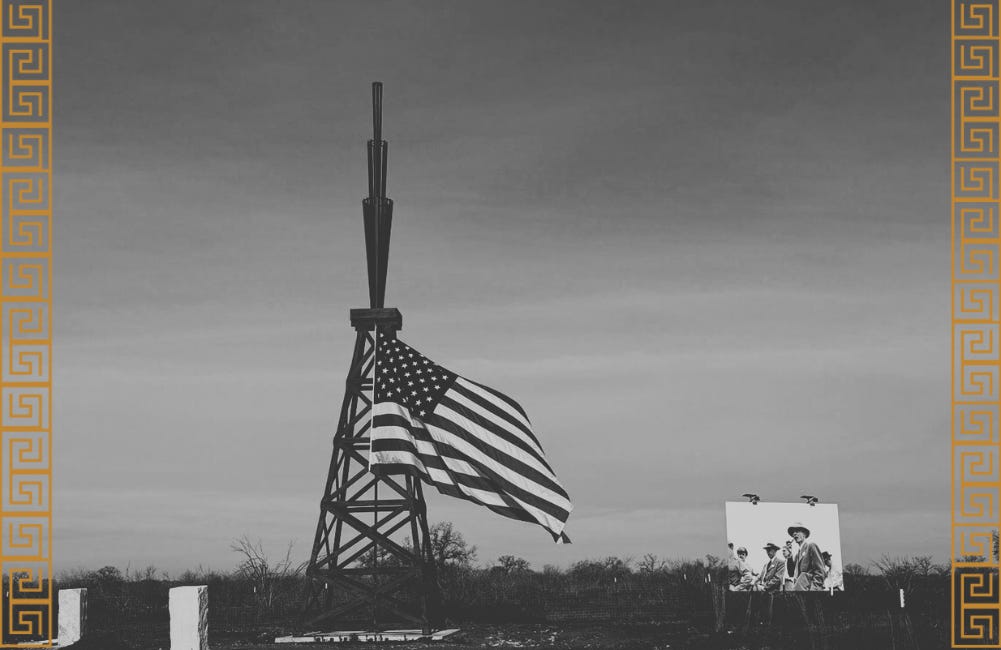

A few weeks ago I stood in a field outside Lockhart, Texas, and watched our 10 ft George Washington statue come off a flatbed truck. He had crossed the Atlantic Ocean in a shipping container. Left outside, he would not survive one winter.
Western civilization is roughly three thousand years old. America is two hundred and fifty. In all that time, what have we made that lasts?
Almost nothing. Whatever survives that long is usually a monument. The Pyramids of Giza have stood for roughly five thousand years, and one of the oldest known megalithic structures on Earth, Göbekli Tepe, is thousands of years older still. The people who raised them are gone, and nobody is sure why some of them were built. The stones are still here.
In “Ozymandias,” Shelley’s traveler finds two vast legs of stone in the desert and a shattered face half sunk in the sand, under a boast that reads, “Look on my Works, ye Mighty, and despair!” Nothing beside remains. The poet Robinson Jeffers, writing to the stone-cutters fighting time with marble, calls them foredefeated, and then reminds them that stones have stood for a thousand years anyway.
Remove every human from the Earth tomorrow and the pattern repeats. Paper rots. Servers fail. Inside a few thousand years almost the entire record of us is the Colosseum, Stonehenge, and Mount Rushmore. Everything else we ever knew about ourselves leaves with us.
In Liu Cixin’s Three-Body trilogy, there is a passage where people try to preserve humanity’s knowledge for the rest of time. They work through every clever modern option, and the answer is the oldest one there is: carve it into stone, the way cavemen did. The Long Now Foundation is building a clock inside a West Texas mountain, engineered to keep time for ten thousand years. Almost nobody builds for the deep future.
At More Monuments, we built a massive wood and steel monument to Spindletop, the oil gusher that industrialized Texas. We built it in four months and it might last fifty years. We created our George Washington statue in plaster. Kept inside, it would last for hundreds of years. If we built that same Washington at scale in stainless steel, it would stand for over a thousand. Our small, made-in-America busts of Theodore Roosevelt are made of resin. Set one outside and it would be ruined within a year. Every one of those is a different wager against entropy. Pick the material and you have picked how long you get remembered.
This is a strange thing to spend your twenties on.
Shakespeare makes the best argument against everything we do. Sonnet 55 bets on the poem over the statue: not marble, he writes, nor the gilded monuments of princes shall outlive this powerful rhyme. And he was right. Almost certainly, more people have read those sonnets than have ever visited a monument to any English king.
But a poem needs a reader. It needs a language still spoken, a literate population, and an unbroken chain of custody four hundred years long. Snap any link and the poem is gone. A statue needs none of that. It needs a person with eyes. Keats knew it. He faced a Grecian urn that had outlasted whole generations and found it still speaking, a friend to man, insisting that beauty is truth, truth beauty. We can still read the expression on a face carved before writing existed, and we still cannot read Linear A.
Words travel further. Stone survives worse conditions. If you are betting on a future that looks like the present, write. If you are betting on a future that does not, sculpt.
The longer a statue lasts, the more people it stands in front of.
Rilke stood in front of a Greek torso once, headless, armless, half a statue, and swore it was staring back at him. His poem turns on the reader: you must change your life. A broken rock gave that order.
You can close a book. You can decline to open it. You can be born after the last person who spoke its language. A monument is in your way. Bigger than you and indifferent to whether you are interested.
So we built an argument and left it standing in a field. On the Fourth of July, five hundred people came to an America 250 party at Proto-Town outside Lockhart. There was food, music, and a hundred better things to do than read. Parents walked their kids over to it. The adults kept a few feet back. And then they read the plaque at its base.
It opens: “It has become imperative to reignite the spirit of the men who invented the greatest country in the history of the world.” And it ends by admitting what it is. A plaster model for a monumental version, which we hope will become permanent.
The statue is what stopped them. The plaque is what we had to say. They could not help but hear us out.
None of it lasts forever. Not even the pyramids. What matters is what you choose to build while you are here.
John Ruskin wrote in 1849 that when we build, we should build forever, and make the kind of work our descendants will thank us for, so that one day they look at it and say, “See! This our fathers did for us.” The first line of that passage is engraved into the lobby floor of the Tribune Tower in Chicago.
The statue is not only for the people at that party. It is for people none of us will ever meet. I want America to be eternal, and that only happens if somebody keeps telling the future who we were. Otherwise the Great Forgetting wins.
Everything decays. Build anyway.
Mo Mahmood is the founder of More Monuments, an organization bringing back large-scale art and celebration to America. Follow his progress at Mo Monuments on X.
 | A guest post by
|
I found this very interesting, a sound perspective, well produced, but I would rather you spent a little time considering a greater message.
The message I would want to create in stone would be an upside down circular pyramid, balancing on its point. It would represent Humanity - the whole of its history written from bottom to top, like on a Roman column, upon its enormous almost infinite wall. The history would consist of the repeated failures we have inflicted upon ourselves due to our Pride and Selfishness enacted through Arrogance and Hatred towards others. The top, a vast flat surface that covers all, represents Heaven, the place where our Creator God resides. He has been there all along, sheltering us, simply waiting to welcome those few who may have sought to reach the top directly while most have seen nothing but empty space.