

The End of Energy Dominance
Permitting reform can’t salvage an anti-development worldview.
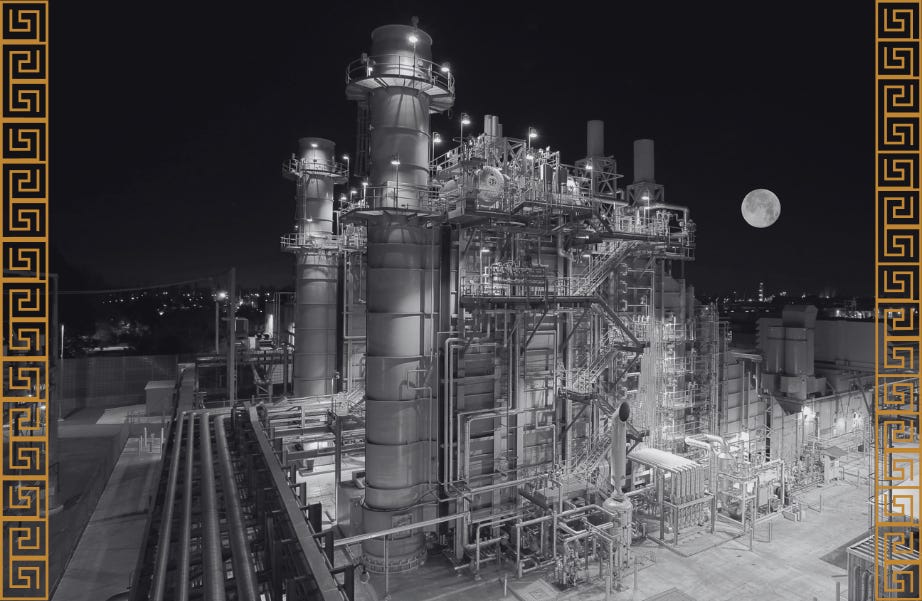

Energy abundance once appeared synonymous with development in the United States. No endeavor enjoyed more conducive natural endowments, better united the exceptional qualities of the American people and their land, and exemplified the unique strengths of American civilization, than the pursuit of energy. In harnessing the singular potential of their country’s natural resources to do useful work, and to fulfill the promise of national development, Americans best expressed their defining virtues in their own improvement and improvement of all mankind.
Generations of builders, inventors, scientists, and statesmen rose to the physical challenge that the Founders accepted when they declared independence two-hundred-fifty years ago. No longer foreclosed by the constraints of British colonial rule, the industrialization and infrastructural integration of the new nation would require an enormous outpouring of Americans’ vital energy and the physical energy embedded in their environment.
To meet these demands, Americans harnessed the power of their rivers, mined mountains of coal to electrify cities, and first tapped the immense potential of chthonic oceans of oil. Energy innovation matched the speed, scale, and ambition of their efforts, and relentless exploration yielded new resources that honed new technologies and techniques. In 1859, Edwin Drake proved the first commercial oil well in southwestern Pennsylvania. The subsequent decades of advances in refining enabled petroleum to keep pace with the proliferation of automobiles during the first half of the 20th century. Petroleum-powered transportation remains energy’s single-largest end-use in America, comprising 37 percent of consumption in 2025.
Advances in electrical power, which carries the converted energy of primary resources, magnified the technological, commercial, and civilizational effect of energy abundance. Thomas Edison pioneered the commercial generation of electricity and its distribution to supply the network of his customers’ electric lights. The Tesla-Westinghouse polyphase AC transmission system demonstrated the possibility of distributing power over great distances from a central generating station.
As productively as it mixed Americans’ talents and labors with their land, the ceaseless pursuit of abundant energy alloyed private initiative and public stewardship. Governments created the conditions for energy development, affirming property rights alongside federal and state laws that created clear guardrails around the use of land, water, and natural resources.
But from the early republic, government also supported projects that could secure abundance. At the nadir of the Great Depression, the federal government commissioned many energy projects and built the nation’s largest power plant. Monumental energy projects such as the Grand Coulee Dam embodied the government’s vision and capacity to build beyond existing demand to form the foundation for future growth.
The cumulative achievements produced history’s only example of energy dominance—when the free world depended on the energy resources, technology, and expertise that America alone could muster. At the outset of the Second World War, America produced 60 percent of world oil, supplying 85 percent of the allies’ wartime demand. Massive investments such as Grand Coulee that seemed speculative a few years before bore fruit; that solitary (albeit enormous) dam powered the production of 30 percent of wartime aluminum.
In the postwar era, Americans pioneered new technologies that promised an eventual end to America’s reliance on exhaustible fossil resources. As before, private industry had Bell Labs’ invention of the photovoltaic cell in 1954, and visionary government such as the first civilian nuclear power plant built at Shippingport, completed in 1957, under the aegis of Admiral Hyman Rickover. In achieving abundant energy, America seemed to have secured an unassailable foundation of industrial power and strategic preponderance.
While American energy dominance, alongside America’s wave of postwar prosperity, ended suddenly amid the 1973 oil crisis, few realized that its possible return had already been thwarted at home. The rupture with the age of energy dominance began on January 1, 1970, when President Richard Nixon signed the National Environmental Policy Act (NEPA) into law. Doubtlessly familiar to anyone who has considered the prospect of “permitting reform,” NEPA conferred upon the federal government a statutory obligation to investigate the environmental consequences of every major action it undertook or authorized. Until 2023, the law imposed no general deadline or page limit on the resulting inquiry.
The policy approaches of the preceding two centuries of American energy development were by no means homogeneous or particularly consistent, but the permitting regime precipitated a stark rupture. NEPA presumed the potential for unlimited risks of environmental harm consequent from any significant infrastructure project. This outlook metastasized through the standards, permissions, and procedures created in the Clean Air Act (1970), Clean Water Act (1972), and Endangered Species Act (1973). These self-imposed constraints are the unfortunate inheritance of an ideological age, during which the environmental catastrophism of midcentury liberals triumphed over the material needs of their still-growing nation.
When the Arab members of OPEC leveraged their growing share of world oil production to penalize American military aid to Israel in October 1973, NEPA-based environmental litigation had already hamstrung major energy projects such as the Trans-Alaska Pipeline System for years. By November, Congress hastily passed legislation authorizing the Pipeline, but it should have repealed NEPA. Though one strategic project escaped permitting purgatory through a specific authorization, and many others would survive the process, investing in energy infrastructure became a precarious proposition, even for the federal government.
Rooted in environmental ideology, the permitting regime inverted the longstanding principles of conservation that defined federal policy towards nature, replacing protective foresight with the forestalling—and in many cases, foreclosure—of development. Where clear boundaries had once protected America’s natural heritage, uncertainty now mired infrastructural and industrial projects of any scale. Instead of simply knowing where they cannot develop, American businesses and even government officials have had to ask, “Can I build here?”, spending years and cumulatively incalculable sums to find out. But as the Institute for Progress’s Aidan Mackenzie writes, “The bigger cost is the invisible graveyard of projects that never get built.”
After the oil crisis, the increased risk and implicit cost of investing in American energy turned the nation from abundance toward the acceptance of economization. From 1949 to 1970, primary energy consumption grew 3.3 percent annually; since 1970, it has averaged only 0.6 percent. The recession ended, but the previous trajectory never returned.
The persistence of the permitting regime has blunted. The shale revolution was a return to form, the product of enterprising wildcatters and federal demonstration projects, which made America the world’s largest oil and gas producer and a net exporter once again. In the era of American energy dominance, these resources would have conferred a civilizational advantage enabled by the integrated transportation and production of fuels from primary energy. Yet upstream production has exceeded the more permitting-constrained transportation infrastructure and downstream refining capacity needed to realize such a national industrial advantage even from resources of this scale.
The permitting regime, buttressed by pillars of litigable and enforceable environmental law, presents the most intractable obstacle to restoring the foundations of American energy dominance. Without a replacement that delineates clear boundaries to prevent definite harm and protect lands, the reform or repeal of NEPA will accomplish little to disrupt the effective power of the legislation’s underlying worldview.
In replacing rules with procedures, endless timelines, and subjective administration, the permitting regime created every opportunity for arbitrariness, partisan abuse, and all manner of political-economic perversion. “NEPA is something of a grim reaper for major infrastructure projects and a jobs program for environmental lawyers,” writes Emmet Penney. The law’s decisive innovation was to transform development itself, wherever touched by federal action, into a matter for the subjective scrutiny of administrative lawyers who serve as the sentinels of the law’s anti-development outlook.
Remedying the permitting regime’s harms will require not only the adoption of a replacement legislation but the promulgation of a replacement worldview—one that recognizes the inherent value of energy dominance and affirms the growth of American civilization.

Daniel Bring is executive editor of American Affairs, a quarterly journal of public policy and political thought, and senior fellow at the Bull Moose Project. At American Affairs, Daniel directs research programs, events, and external relations, in addition to managing the journal’s Washington, D.C. office. At the Bull Moose Project, Daniel conducts research on supply chains, reshoring, and resource extraction. Daniel graduated from Dartmouth College with an A.B. in history.