

Orbán in the Mirror
The Global Nationalist — and What the American Right Should Learn Before It's Too Late
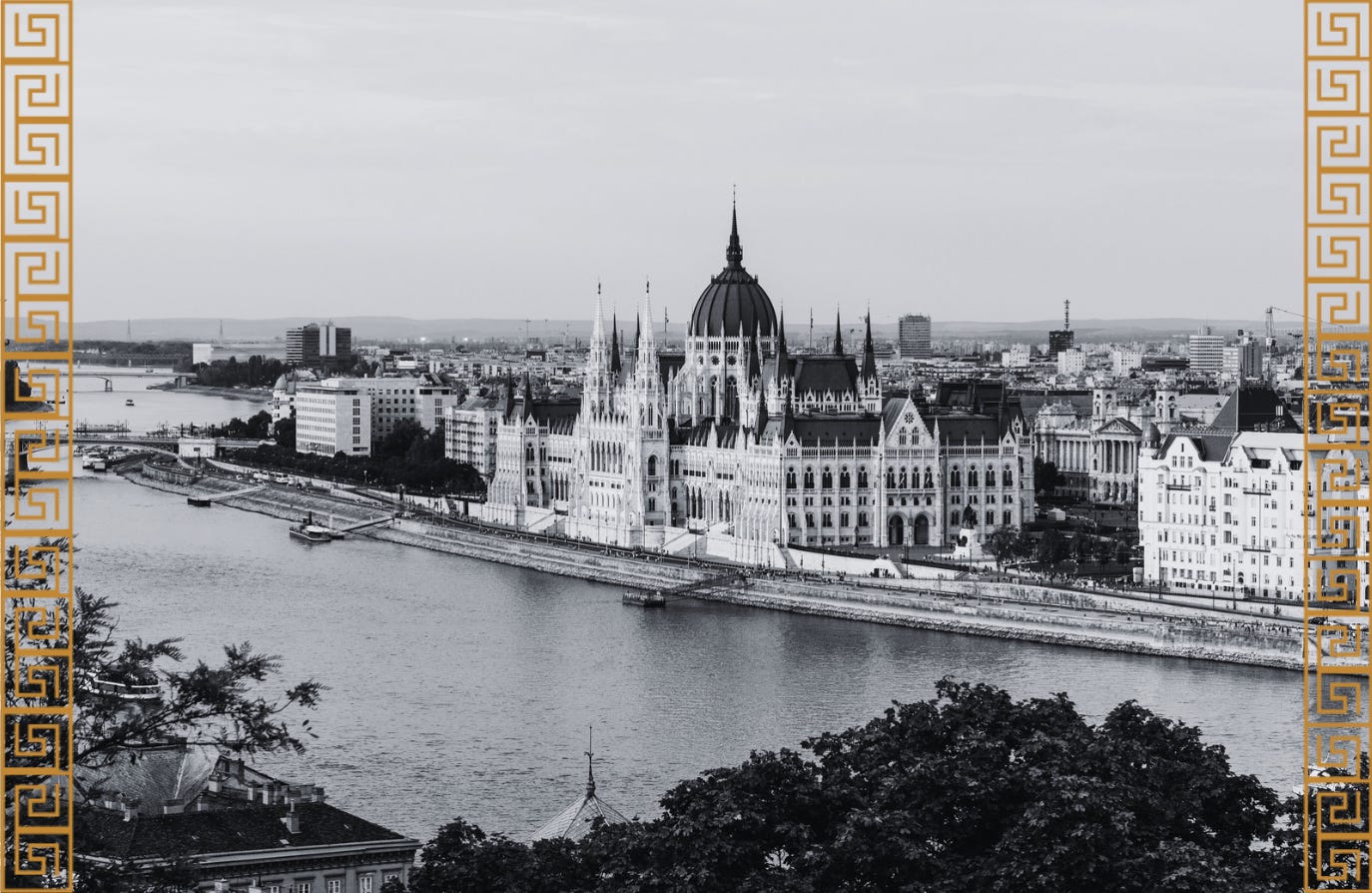

On April 12, 2026, Viktor Orbán conceded defeat after 16 years in power. Péter Magyar’s Tisza Party claimed over two-thirds of seats in parliament – a constitutional majority – with a roughly 80% turnout, the highest participation since the fall of communism. It was a stunning victory for the relatively new party.
If one wanted a reason why Orbán lost after an impressive length of tenure, one can look at CPAC’s annual convention in Budapest, where several European and U.S. influencers and celebrities openly lauded Orbán’s achievements in fighting “the West’s managed decline.” Just a few weeks after CPAC, Vice President J.D. Vance flew to Budapest in a last-ditch effort to boost Orbán. It was ironic that Orbán, who had spent sixteen years presenting himself as a nationalist free from European bureaucrats trying to decide Hungarian policy, was trying to be rescued by American patronage. In 2018, he once railed that Hungary was being threatened by “supranational and anti-democratic forces”; this didn’t prevent him from accepting help from a right-wing apparatus that was as foreign as the EU he decried. The optics revealed some contradictions in Orbán’s tenure: a sovereigntist whose initial economic success came from membership in the EU, a Western civilizationist who enjoyed closer ties with nations like China and Russia determined to sabotage it, and a man whose narrative couldn’t match reality. Yet Orbán didn’t lose because his project failed. He lost because his project in many ways succeeded; the Hungarian people just decided that Magyar would be a better steward for such a project.
Before going further, it’s important to know that Orbán was not a dictator. The opposition campaigned openly, ballots were counted fairly, and there was no constitutional crisis when the opposition won. Hungary has no political prisoners, and unlike the United Kingdom or Germany, it does not jail citizens for social media posts. Framing Hungary as under the grip of a “Viktator” is misleading at best and harmful at worst. Orbán was a skilled democratic politician whose work, while partly kleptocratic, was a mirror image of what progressives have done throughout Western Europe and the United States.
When Orbán took power for a second time in 2010, Hungary was in dire straits due to the 2008 economic crisis. Hungary was at risk of default and required an IMF bailout package, with hundreds of thousands facing homelessness due to foreign-denominated mortgages. Orbán promised economic rejuvenation alongside a nationalist agenda that would help Hungary restore some of its national pride. The unorthodox measures Orbán introduced — the flat tax, the nationalization of private pension funds, the sector-specific levies on banks and multinationals, and the administrative cuts to household utility prices — stabilized the country faster than expected. Hungary repaid its IMF obligations ahead of schedule in 2013, giving the government the credibility it needed. Unemployment fell from over 11% in 2010 to under 7% by 2015, then continued to decline to 3.5% by 2019, well below the EU’s average. Public debt declined from roughly 80% of GDP to 65% by 2019. Real GDP growth averaged 2.7% annually in the second half of the 2010s, consistently above the EU average. In the 2010s, the macro indicators vindicated the project, and many conservatives considered Hungary a viable model given Orbán’s great start.
His economic achievements pre-COVID were laudable, though how he achieved this also bears some perspective: he built an economy more dependent on foreign capital than before. Many companies invested in Hungary because the country’s 9% corporate income tax was the lowest in the EU, but they were also drawn by low wages and lax overtime regulations enacted under the Orbán government. Additionally, Hungary’s position in Europe provided additional funds for the government which it could then use to bolster its economy. Under the EU’s 2014–2020 Multiannual Financial Framework, Hungary received roughly €22.5 billion from other members, an average of 3.2 percent of GDP per year, the highest share in the region. These funds helped subsidize his domestic patronage and stabilize its fiscal situation, even as he increasingly became an irritant to Brussels bureaucrats. In many ways, Europe subsidized his claim to maintain his popular subsidies and tax breaks without making the populace pay for them, at least until the EU froze distribution in 2022, weakening his economic agenda.
As Hungary’s relationship with the EU deteriorated, its relationship with Russia grew. Hungary was a consistent spoiler within the European Union and NATO, vetoing or delaying successive Ukraine aid packages, blocking the bloc’s efforts to freeze Russian central bank assets (which were eventually circumvented under Article 122), and holding up Sweden and Finland’s membership in the military alliance. While Orbán agreed to some sanctions against Russia, he forced the EU to renegotiate their renewals every six months as leverage. Orbán was a (relatively) friendly leader to Russia when the country was effectively isolated from Europe, leading to continued energy imports from Russia and Rosatom’s expansion of the Paks II nuclear plant.
Another hypocrisy in Orbán’s narrative lies in his signature issue: migration. From 2015 onward, Orbán focused on migration, from building the border fence to framing migration as “the great replacement” theory that many foreign conservatives spoke of. While the details of the great replacement theory espoused on X are both uncouth and inaccurate, Orbán’s tough policies on migration saved Hungary from the societal destabilization currently impacting other European Union member states. To make up for the lack of mass migration, Orbán sought to encourage the birth rate through generous social policies, such as reduced tax rates for families and home grants, which temporarily boosted the fertility rate to 1.61 births in 2021, up from a low of 1.23 in 2011.
However, what he did to boost the labor force in the short term was a guest worker program that, by the mid-2020s, was bringing in workers from the Philippines, Vietnam, Indonesia, and Central Asia. As Orbán bragged that they will not accept a single migrant, several firms were petitioning to hire guest workers, even as some announced a hiring freeze against Hungarians given these workers can take lower wages than domestic workers. Orbán and his party may state that the program is highly regulated and is different than illegal immigration, but it does undercut the message that they’ve promulgated through CPAC and the well-funded right-wing think tanks. It is jarring that Orbán’s government is allowing immigration that bears some resemblance to the controversial H-1 B visa scheme in the U.S.
For several years, many well-paid American and European intellectuals in Budapest fawned over the country’s defense of tradition, affordable living, and the lack of quality-of-life issues like crime they’ve seen in the U.S. and Europe. Yet step outside the nicer parts of Budapest, or talk to Hungarians outside of Orbán’s network, and one sees a different story. GDP per capita in purchasing power parity terms is 77 percent of the EU average, ahead only of Slovakia, Latvia, Greece, and Bulgaria. Actual individual consumption per capita, the measure closest to lived material living standards, was the lowest in the entire European Union at 72 percent. Since 2022, GDP growth has lagged the EU, with the economy growing a measly 0.3 percent in 2025. Concurrently, inflation is consistently higher than the Eurozone average. The budget deficit, which was running high due to continued tax cuts, was projected by IHG to be 5 percent of GDP, with public debt rising to ~74 percent of GDP - similar to where it was in 2008. The economy may have done well in the 2010s, but the shocks have shown that Hungary’s model is not much better than the one espoused in Brussels.
Supporters of Orbán in the U.S. may concede that the economy has regressed under Orbán, but they would readily point out that he consistently ensured that traditional values were promoted in the public square. And yes, LGBT laws have stopped advancing, Hungary has not seen mass migration, and the birth rate did recover throughout the 2010s. But the government’s promotion of traditional values has largely fallen flat, especially when scandals broke that show some members’ unfriendly family behavior. The birth rate, after rising to 1.61 in 2021, has fallen every year to 1.31. The incentives only encouraged people to have children earlier in life, but did not encourage them to have more children than they originally planned. Furthermore, Orbán has failed to preserve Hungary’s religious traditions, as ~30% of Hungarians consider themselves Catholic and only 17% attended worship monthly. While Hungarian religiosity is better than in Germany or Belgium, it is lower than in Fico’s Slovakia or even Tusk’s Poland. And lastly, while the government extolled family virtues, several officials were caught acting in the opposite way. József Szájer was caught in Brussels in 2020 attending a gay orgy, forcing him to resign. In 2019, Gyor’s mayor, Zsolt Borkai, was also caught, though his crime was being on a yacht with prostitutes and drugs. And lastly, there was the Konya scandal, where the President of Hungary, Katalin Novák, gave a presidential pardon to Endre Kónya, the deputy director of a state children’s home who had been convicted of helping to cover up sexual abuse of ten minors by his superior. Ironically, this scandal directly triggered the political rupture that made Magyar Orbán’s most effective opposition challenger in sixteen years.
The issue is that Orbán subordinated governance to the creation of a narrative. Economic policy was optimized for elite loyalty instead of broad-based prosperity. Foreign policy was optimized for international visibility as a civilizational icon rather than for strengthening natural allies. Immigration policy was optimized for the electoral content it generated showing himself as a defender against migrants that would threaten western civilization. Even the utility price caps and family subsidies, which did deliver real benefits to real households for a real stretch of time, functioned more as a narrative device than as a sustainable policy, which is why they failed the moment external shocks hit them. Sadly, Orbán became a contradiction of his own making, performing nationalism while detaching from the long, hard work of building national capacity. This worked for sixteen years because voters allowed it to, so long as they received what was promised. When the material benefits collapsed amid double-digit inflation and frozen EU funds, the transaction fell through, and they voted for a candidate who promised change.
The United States is not Hungary, but Orbán’s defeat is a warning about what can happen if populists mistake narrative for capacity, alliance-breaking for strategy, and loyalty for competence. Common Hungarians tolerated so much before they opted for a more genuine nationalist alternative. Talking trash about the opposition and calling out “the left” will only work so far as Americans start to care less about what you are against and more about what you have done.
There is still time to make needed course corrections in economics and foreign policy, such as disengaging from the Middle East and focus on making housing more affordable for the younger generation. But if the government decides to continue pursuing a war abroad at the expense of a genuine domestic agenda beyond extending tax cuts, many on the right will find themselves back in opposition, like many of their colleagues in Budapest right now.
The views expressed here are those of the author and do not reflect the position of The New Outlook or the Bull Moose Institute.
Heberto Limas-Villers is a co-founder at a geopolitical advisory firm called SkySeal Global and a Fellow at the Bull Moose Project.
 | A guest post by
|