

Is It Too Late To Avoid Another Butler?
Only a new Square Deal ended the last age of assassinations. We're waiting on ours.
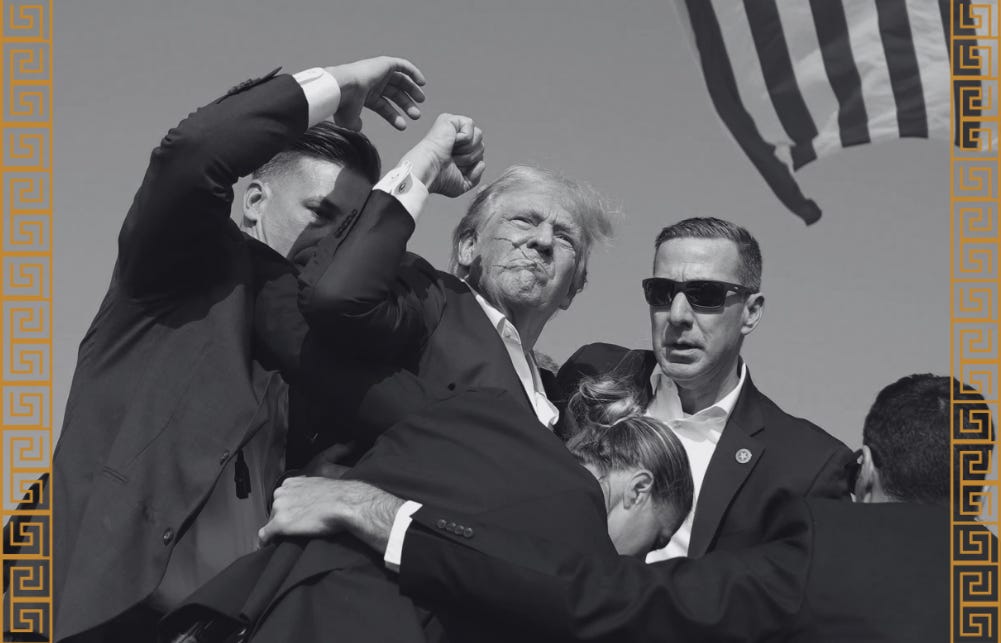

Two years ago, a bullet passed within an inch of ending Donald Trump’s life on a stage in Butler, Pennsylvania. Another ended Corey Comperatore’s instead: Corey, a firefighter, a husband, a father, was shielding his family in the bleachers. For a moment, the country seemed to understand that something had gone badly wrong.
However long that moment was, it did not last. In the two years since Butler, a second gunman was arrested waiting for the president on a golf course in Florida. Minnesota’s House Democratic leader, Melissa Hortman, was assassinated in her home alongside her husband. Charlie Kirk was murdered on a college campus in front of thousands of students. An arsonist set fire to Governor Josh Shapiro’s residence while his family slept inside, and this April, a gunman stormed the White House Correspondents’ Dinner with a manifesto naming nearly every senior official in the administration as a target.
After every one of these, we have heard the same sermon from the talking heads and political leadership: lower the temperature. Tone down the rhetoric. Remember that we are all Americans. Yet the temperature keeps rising anyway.
It’s worth asking why.
The establishment answer to political violence — the one offered in a thousand similar op-eds and unity addresses since Butler — treats overheated rhetoric itself as the disease. If everyone would simply speak more gently, the theory goes, the violence would stop. So after every outburst of horrific, targeted killings, we get the ritual calls for calm that are addressed to no one in particular, demanding nothing in particular except kind words, from figures whose main activity consists of debating an empty chamber for clicks.
These leaders don’t understand that this kind of rhetoric is the fever, not the infection. The civility sermon fails because it allows the speaker to seem responsive to violence without ever asking what is truly producing it, and once settled, acting to fix it.
The rhetoric of the last decade is not overheated by accident. Millions of Americans, on both sides, sincerely talk about our politics in existential terms — fascism, tyranny, the last election, the end of democracy — because they experience it that way. Telling them to stop describing what they feel is akin to giving painkillers to a cancer patient – temporarily reducing discomfort, but with no change to the end result.
Henry Kissinger, near the end of his life, offered a better explanation. Trump, he said, “may be one of those figures in history who appears from time to time to mark the end of an era and to force it to give up its old pretenses.”
That is what is happening, and everyone can feel it even when no one says it. The post–Cold War order is dying. It has been dying for a decade, with no replacement in sight.
Era transitions do something dangerous to a democracy: they make every election feel final. Those invested in the old order do not experience its passing as a policy dispute; they experience it as the end of the world they were promised, and they reach for the vocabulary of emergency.
Those building what comes next do not experience the old guard’s obstruction as ordinary opposition; they experience it as sabotage by a regime-in-exile that refuses to accept it lost. Both sides come to believe, with complete sincerity, that the other’s victory is not survivable.
When politics becomes existential for the many, it becomes eliminationist for the unstable few. The behavior of the most recent list of targeted assassinations are what “this is our last chance to stop them” looks like in the world beyond media clips and podcast interviews.
This is why the temperature will not come down on request. The stakes are real because the question underneath them — what kind of country replaces the one that is passing away — is real, and it has not been answered in a satisfactory way.
The truth is, America isn’t close to the end of targeted violence; we are most likely stuck in the middle of its lifecycle. A transition between eras consists less of specific events, than periods where the establishment is too weak to assert its dominance and the new one is too fluid to consolidate into a cohesive movement. These periods tend to last at least a decade, if not two, and during that time, every election will be fought as though the republic itself were on the ballot. In a sense it is, though not the survival of the country per se, but the shape of its institutions and governing framework.
However, there’s a difference between a turbulent decade and a violent one.
The 1890s were the death of an era too. Industrialization had shattered the old agrarian republic, and a new economy had benefitted urban monopolists over the mass of factory workers and farmers. That new status-quo was not accepted by many, and the result was a country consistently at war with itself. The Homestead and Pullman strikes led to the deployment of federal troops, and an anarchist even shot Henry Clay Frick, then Chairman of Carnegie Steel, at his office; and another even assassinated President William McKinley.
It wasn’t a call for civility alone that finally broke the violent undercurrents in American political life. President Theodore Roosevelt, who had inherited the office from McKinley’s death, launched a cohesive effort to protect Americans from the worst abuses and deliver substantive quality of life adjustments. The Square Deal broke the trusts, policed the corporations, took the side of the ordinary man against concentrated power, and proved that the government could still be made to work for the people who had lost faith in it. The violence stopped because reforms in the government, paired with a crackdown on violent and radical ideologies, started delivering for America and securing their liberties.
That’s the only way forward. It’s more difficult than a call for conciliatory speech, but the temperature will only come down when the transition from one system to another is completed.
That means the guardians of the old, establishmentarian era must accept that it is over, and that the movement replacing it is a legitimate expression of the American people rather than an emergency to be suppressed by whatever means available. It means the new coalition must prove it can do more than disrupt — that it can and must govern, deliver, and rebuild, so that the average American’s stake in the system is a working country. And it means both restoring the one conviction without which no democracy survives: that elections settle things, and that losing one is survivable.
Is it too late to avoid another Butler? The attempt, probably. The country in which such attempts keep coming — no. That country will not be talked into existence. It will have to be built, the way Theodore Roosevelt did the last time an era died: with a square deal.
Aiden Buzzetti is the President of the Bull Moose Project. You can follow him on X @AidenBuzzetti.
One thing that will be a problem is toi many confuse changing their place in the system with actually changing the system. See too many younger people who's politics are "I DESERVE to be in the position of a certain slice of Boomers, the rest of you are peasants who deserve to suffer". Or that certain structures of the old system will be around to leech from.