

Inside Reindustrialize: America's Industrial Revival Finds Its Convention
America's Reindustrialization Movement Is Here to Stay
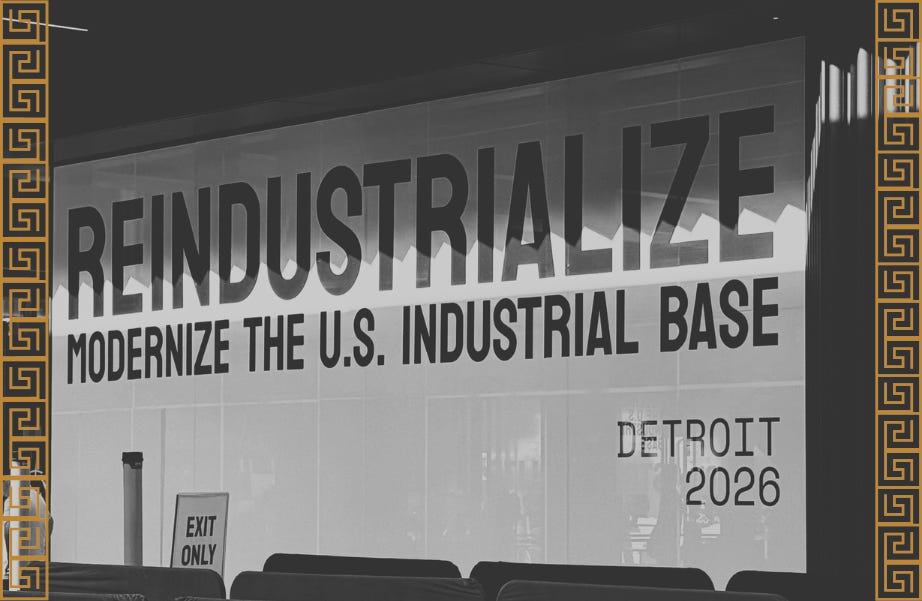

The Reindustrialize Summit was held this week in Detroit, Michigan. Jokingly called “nerd Coachella,” the conference attracted a litany of government officials, venture capitalists, innovators, and industrialists all seeking to reshore American industry and create new technologies that drive forward a dominant American future.
Reindustrialize being located in Detroit is not an accident, of course. The Motor City was once America’s fourth largest, peaking in the 1950s with a population close to 2,000,000. It dropped out of America’s top ten most populous cities by 2010 – and over the last 25 years alone has lost roughly 300,000 residents, with the current population sitting at around 650,000.
The city is dotted with ghosts of greatness, from looming gorgeous skyscrapers to the headquarters of companies which once powered the city and America, such as General Motors, still refusing to decamp. But throughout, there is evidence that it is slowly reviving, as its downtown and outskirts are dotted with new industrialists and industrializers, like Newlab, which plays host to hundreds of budding companies working to re-build America.
The conference itself is effectively split between presentations, whether speeches or panels, and exhibits. The presentations vary broadly, from household names like SBA Administrator Kelly Loeffler, UN Ambassador Mike Waltz, and Chairman Brendan Carr of the FCC to private-sector voices such as Erik Prince, Chris Power from Hadrian, and a wide array of manufacturing and defense startup founders. The wide array and number of speakers meant that the average span of the panel presentation was roughly 20 minutes, which has the added benefit of trimming the fat and bluster common to many multi-day events. It makes sense, given the jam-packed schedule and oddly specific topics. There’s no room to drone on endlessly about the defense industrial base, critical minerals, and the supply of energy. These speakers knew what the problems were from firsthand experience, and they weren’t shy about sharing it. The conference speakers and attendees were young, patriotic, and remarkably focused on the actual goal of eliminating bottlenecks and actually building in America again.
Outside was an exhibition hall where companies large and small could show off their latest creations. Much of the floor was taken up by the future of warfare, from a myriad of drones and anti-drone tech to software meant to streamline the production in our defense industrial base. Not all the exhibits were oriented toward warfighting, however; companies like Ohio’s LAND, which produces e-motorcycles and the weather-augmenting Rainmaker were also showing off their latest. The founders and engineers themselves were often remarkably young, some of whom walked away from comfortable jobs to build autonomous systems and set up tech-heavy foundries, itself a bet that the next decade will reward atoms, not bits.
But there’s also a third part of Reindustrialize: the meetings on the side of the event. There, in quiet, (or shouted, when protestors were nearby), conversations, attendees were able to truly get a grasp on the state of American reindustrialization.
Politics played little role in these conversations; though there were administration officials present, just as there were Biden administration officials at Reindustrialize’s first iteration in 2024. Partisan bickering was put aside. Instead, all the innovators present, no matter what their political stripes were, all aligned on one idea: that American industrialists are desperate to build in America and replenish the country’s depleted industrial base. But what was also unfortunately apparent, throughout these conversations, is that there are still serious barriers to being able to fully build in America.
Part of this is due simply to the state of reindustrialization, which only became a concerted effort after President Donald Trump’s first election victory. Ten years, also interrupted by COVID, is not a long enough period of time to reverse decades of purposefully-engineered offshoring and the gutting of critical industries and infrastructure.
But speakers also made clear that there were still things Washington could be doing – from cutting decades-old regulations which make building obscenely difficult to provide funding for autonomous construction. What reindustrialization actually means for them is the policy substance underneath the sloganeering. Industrial sovereignty isn’t just a border argument. It’s about whether you can produce your own steel, chips, ships, and weapons without asking permission from an adversary’s supply chain.
Looming over the conference was the threat of China, and the concern that the CCP is no longer simply copying American technology but is instead industrializing in ways America, or at least other Western countries, cannot hope to match in the short- or mid-term.
This is why the concept of reindustrialization is an America First issue but also largely a cross-partisan one. There are some machines that no one in America owns or knows how to operate and the only option is to manufacture them in China. The sovereignty of the American people is at risk when we rely on a foreign adversary, or in some cases, friendly foreign nations, to produce components that we then assemble at home. While jobs and investment are key parts of reindustrializing, there’s more to the story. By bringing back factories and skilled trades, Americans themselves are participating in a broader national mission for the benefit of their families and countrymen.
Even though this is only the third Reindustrialize conference, it still feels like it’s just the beginning. One can easily imagine in ten or fifteen years attendees and speakers will not be discussing how to reindustrialize America – but how a reindustrialized America, newly confident in itself and in the potential of its citizenry, should proceed.

In a slight deviation from the regularly scheduled releases, the New Outlook team attended the recent Reindustrialize conference hosted in Detroit, Michigan.
Written by Aiden Buzzetti, Anthony Constantini, and Evan Riggs.