

How This All Could Fall Apart
What Roosevelt’s Collapse Teaches About the Fragility of Rising Movements
Political realignments take longer than people realize. Andrew Jackson’s reshaping of American politics took a full twenty years (1824 to 1844). So did Franklin D. Roosevelt’s (1932 to 1952), which still needed a fifth term from Harry Truman to lock in FDR’s changes.
The common argument, that it’s enough to have one influential two-term president (or three terms, if followed by a successor), is simply wrong. Ronald Reagan was followed by a successor, granting over a decade of power; but beyond forcing Bill Clinton to pretend to like smaller government for a few years, it failed to fundamentally change the US government. Even the first two presidents, George Washington and John Adams, failed to achieve dynastic, long-term political success, with Thomas Jefferson’s Republicans effectively transforming America into a one-party state for – you guessed it – roughly twenty years.
President Donald Trump’s America First movement – which has replaced the milquetoast fusionism in the GOP with industrial democracy, which seeks reindustrialization at home and realism abroad – is ten years into its realignment. It likely has ten years to go before being able to say it has vanquished its ideological opponents within the GOP and, more importantly, remade American politics in its own image. If it wants to succeed in that goal, it must avoid mistakes made by past attempts at forcing realignments.

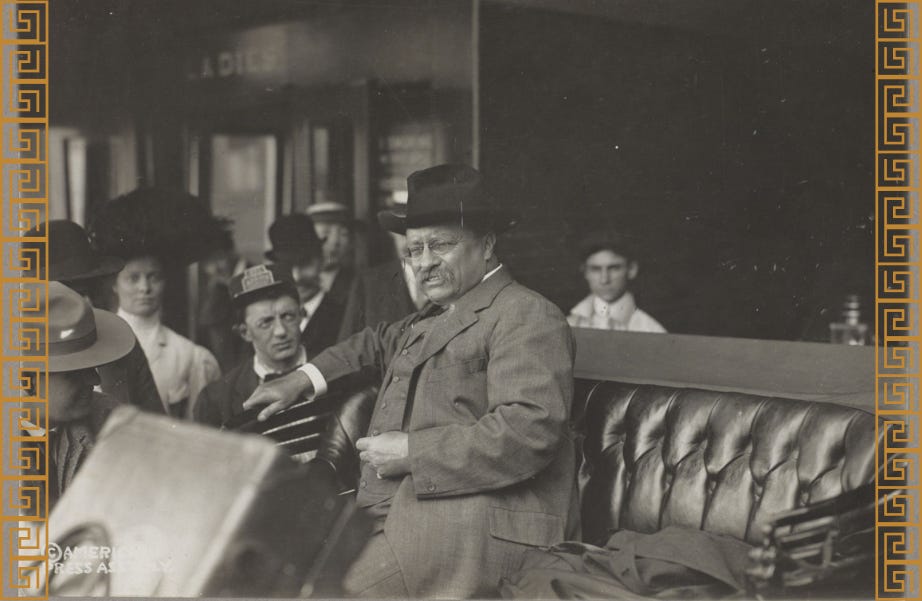
It was early 1915. Theodore Roosevelt’s Progressive movement had been smashed in the previous presidential election. The Republican Party had no real leadership. War had broken out in Europe, and Woodrow Wilson was dithering over whether America should get involved.
Yet Roosevelt was happy. Writing to his son, Kermit, he said there was a benefit to “the smash that came to the Progressive party”:
We did not have many practical men with us. Under such circumstances the reformers tended to go into sheer lunacy. I now can preach the doctrines of labor and capital just as I did when I was President, without being hampered by the well-meant extravagances of so many among my Progressive friends.
Now that Roosevelt was finally free of the radicals – men who seemed to prefer the moral victory and the title of “Leader of the Opposition” rather than the electoral victory and the title of President – he could propel his movement back into power. In 1912, his party had run on destroying the “invisible government,” which owed “no allegiance…to the people” and was run by both mainstream parties.
It didn’t happen. Roosevelt did not run in 1916 – the political wounds from 1912’s fallout were too fresh – and died in 1919. His expected heir, Leonard Wood, failed to win the GOP nomination in 2020; that honor went to compromise candidate William G. Harding, a conservative who immediately cut taxes and allowed corruption to flourish upon winning the White House. Harding was followed by Calvin Coolidge, who was arguably even more conservative, and then by Herbert Hoover, who – though more progressive than the other two – failed to really enact any progressive legislation due to the Great Depression.
Instead, it was the Democrats who soon seized the progressive label, with Roosevelt’s cousin, Franklin D. Roosevelt, remaking the federal government and reshaping American politics for the following half-century.
There is an alternate history in which Roosevelt is able to “progressivize” the GOP in the late 1910s, with he or his heir taking power in 1920. But this failed to occur, primarily for three reasons.
The first was the issue with what Roosevelt termed the “sheer lunacy” of some reformers. Many of those who surrounded the progressive movement were truly radical. The party’s platform called for an end to state’s rights, the creation of a “national health service,” the strengthening of inter-state commerce regulation, and “the distribution of immigrants away from the congested cities” to the countryside, among others. Individuals associated with progressivism, such as California’s Hiram Johnson, were ornery, agitated characters who found needing a coalition to be a nuisance.
The second issue was that the politics of Roosevelt’s extreme supporters were his own politics. Yes, he was correct in being pleased at the jettisoning of the “sheer lunacy” of some reformers and opposed the stringent pacifists in 1912’s Progressive Party. But Roosevelt himself ultimately endorsed the 1912 platform and personally attacked Taft – who had been his friend – and Taft’s administration, which was full of Republicans who had supported Roosevelt in 1904. His platform on its own was not necessarily an anvil around his movement’s political chances, but the platform being combined with Roosevelt’s hostility to all who opposed his ideas was what did him in.
It is this third issue, Roosevelt’s strategy – namely, a complete unwillingness to build a coalition – which was the most damaging. Roosevelt had selected Howard Taft as his successor but turned sharply on him in 1912 while failing to specify precisely what Taft had done to anger him. By all accounts, Roosevelt could have waited for 1916 to recapture the White House; had he done so, his movement would have survived and perhaps even thrived. In 1920, progressives likewise had a chance; but Roosevelt’s expected heir, Leonard Wood, proved incapable of really working with anyone else. Hiram Johnson even was asked by Harding to be vice president, but he deemed the role unacceptable.
Which is, of course, a historic irony, as Johnson would have found himself president – and his movement back in charge – just three years later due to Harding’s unexpected passing.
Other successful realignments were built on coalitions. Andrew Jackson built his movement this way, demanding fealty on a few key issues (such as the bank, democratization, and respect for the primacy of the federal government), but allowing for differing views on much of the rest. The same is true of FDR; his Democrats were extremely broad-based, with senators and congressmen coming from all parts of the political spectrum.
The crucial mistake was that Theodore Roosevelt was not willing to acknowledge that it would take time for the older, conservative Republicans to be converted or weeded out of the party. Roosevelt should have treated the Republican Party as a fundamentally progressive organization with a large minority of conservatives and, over time, assuaged and massaged the views of the latter out of the party.
President Trump, and the America First movement, is fortunate that it has already been able to avoid some minefields. The 2020 election, unlike Roosevelt’s disastrous 1912 election, arguably strengthened the America First movement by shaving off those who, in President Trump’s first term, were still tied to old ways of thinking. Having re-taken power a year ago, the Trump administration is now busy destroying the Deep State – analogous to Roosevelt’s hated “invisible government” – and, in doing so, are finding great success.
But there is still time to make mistakes. In 2028 President Trump should, like Andrew Jackson did in 1836 and 1844, clearly select a successor. It is the norm that a president does not endorse their vice president until the primary is effectively over: Reagan, Clinton, and Obama all did not endorse. This should change.
Those of us who adhere to America First also must come to grips that the GOP, while dominated by the MAGA movement, still has pockets of libertarianism or those who liked the old ways. These differences are borne out in debates over H-1B visas, support for Israel, and even the extent to which tariffs should be utilized.
None of this is to say that those who are supportive of President Trump’s realignment should back down, nor that they should even be less reactionary in their stated intentions. However, we must acknowledge that progress on changing the party will be slow. Had victory come in the vein of Franklin Roosevelt’s 1932 smashing, the situation would be very different. But the popular vote was won on the backs of those who are not perfectly aligned with us ideologically.
What that means is that over the next ten years we must work to massage them out of the party. This will not be difficult, as time is literally on our side: twenty years is the span of a generation. As time marches forward, younger, like-minded staffers will trickle up – to invert a fusionist phrase – into the party superstructure. Those who are increasingly less aligned will slowly be weeded out, and the realignment will be complete.
Absent a titanic economic disaster, the only thing which can stop us is ourselves. We can shape the future – but only if we respect the tides of history.
Anthony J. Constantini is a policy analyst at the Bull Moose Project. He is writing his Ph.D. on populism and early American democracy at the University of Vienna in Austria and tweets at @AJConstantini.