

A Nation That Can't Build Will Be Ruled
Sovereignty Is Built, Not Declared
By Patrick J. Wolf

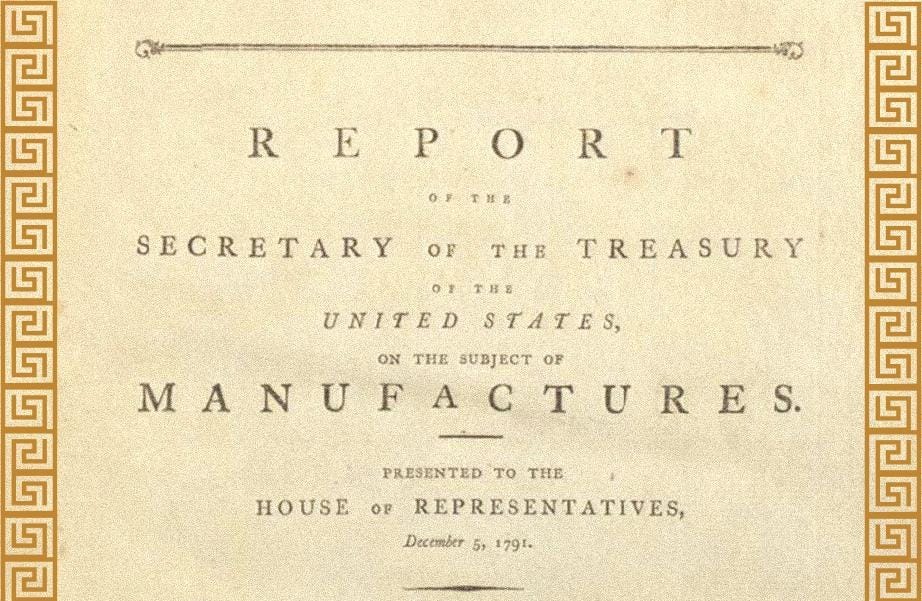
As Alexander Hamilton argued in his Report on the Subject of Manufactures (1791), a nation must cultivate its industry to avoid dependence on foreign suppliers for military and other essential goods, a cornerstone of true independence rather than merely diplomatic recognition. Sovereignty is not created by treaties or recognition, but rather it is sustained by the capacity to act without asking permission. A nation is sovereign only if it can build, repair, move, and control itself. Weakening these capacities turns independence into a formality instead of a reality.
Dependency as the Precursor to Constraint
History eloquently illustrates this point in each century, with countless instances of the greatest regional powers deteriorating over time. Material dependence becomes political constraint long before open subjugation. Empires and great powers are seldom conquered outright; instead, they are weakened as reliance on external resources steadily erodes their ability to act independently. Control over grain, energy, shipping lanes, and industrial production has shaped outcomes over centuries.
Logistics and Industrial Power in War
A familiar historical example is Ancient Rome. At critical points in its expansion, the empire became heavily dependent on Egyptian grain to sustain its population and maintain political stability. This arrangement created a strategic vulnerability, as Rome’s internal order depended on the reliable functioning and trade of its outer provinces. Any disruption to grain supplies threatened Rome’s domestic stability and its ability to project power abroad. The center of imperial authority could not feed itself without the continued functioning of Rome’s Egyptian province, and what appeared to be an efficient logistical system became a point of pressure at the heart of the empire.
A more modern example illustrates the same principle at an industrial scale. Britain’s power during the world wars was inseparable from its ability to secure sea lanes and sustain industrial output. During World War II, the German Kriegsmarine targeted Britain’s maritime supply lines to restrict access to food and industrial inputs, seeking to constrain British power without the need for a land invasion.
The United States’ industrial mobilization during World War II further clarifies the relationship between production and sovereignty. American victory was not the product of superior rhetoric or moral clarity alone. Steel, fuel, shipyards, factories, and a vast logistical network formed the backbone of its wartime power. By the time 1943 rolled around, American shipyards were churning out Liberty ships at a pace that outstripped the German U-boats’ sinking capacity. At the same time, the surge in aircraft production allowed for the sustained use of strategic bombing campaigns for years, not just months. The Soviet Union’s capacity to maintain its punishing war against Germany was, in large part, thanks to American Lend-Lease, which effectively sent entire factories to Russia to replace lost materials on a massive scale.
Europe’s Energy Dependence as a Contemporary Case Study
Industrial capacity is not merely a measure of economic growth but the hidden foundation of national power and sovereignty. In this context, contemporary Europe offers a clear case study in the strategic consequences of dependence. For years, Europe’s biggest economies leaned heavily on Russian energy. By 2021, Russia was supplying roughly 45% of the EU’s natural gas and more than a quarter of its oil. Some countries in Central and Eastern Europe were even more dependent, getting nearly 80–100% of their gas from Russia.1 Europe justified this setup as a smart economic move, pointing to the cheap energy, dependable supply lines, and the system’s overall effectiveness. But when geopolitical tensions flared up in 2022, that efficiency came with a price. Disruptions to the inexpensive Russian pipeline gas left Germany’s industrial base exposed. As supplies tightened, energy-intensive sectors faced the prospect of scaling back production or shutting down altogether. Leaders in Germany’s labor and industrial sectors warned that entire industries, including chemicals, glass, aluminum, and heavy manufacturing, were at risk as energy costs surged and reliable fuel supplies vanished. Plants built around steady, low-cost gas found themselves unable to switch fuels quickly or cheaply, turning what had once been an efficient energy arrangement into a source of acute industrial vulnerability. This crisis compelled Europe to undertake a difficult and costly restructuring; by 2025, Russian gas imports had decreased to 13% of the EU’s supply, supplemented by augmented LNG imports from the United States, Norway, and Qatar, albeit at considerably elevated costs. ² What had looked like sensible interdependence turned into leverage once the political situation changed. Europe retained formal sovereignty throughout, but its range of policy options was constrained by decisions made decades earlier about where to source its energy.
Fragile Supply Chains and Strategic Vulnerability
A nation’s dependency on foreign countries goes beyond energy. Globalized supply chains sacrificed resilience for cheaper costs. The pursuit of efficiency created vulnerabilities that only showed up when the system was put under strain. While just-in-time logistics and manufacturing practices successfully lowered expenses, they eliminated the buffer of sustainable inventory. Semiconductor manufacturing exhibits the same structural vulnerability due to foreign dependency. Heavy concentration in Taiwan and South Korea has created single points of failure for critical industries, including automotive and defense. Medical supply chains were optimized for price rather than surge capacity, a weakness the 2020 pandemic exposed when disruption revealed how thoroughly American production had been hollowed out. Rare earth production may serve as the most significant example of America’s ability to project sovereignty. In 2024, China accounted for roughly 70 percent of global rare earth mining output and nearly 90 percent of global rare earth processing capacity, giving it outsized control over inputs essential to everything from wind turbines to precision-guided munitions. In the same year, the United States sourced approximately 75–80 percent of its rare earth imports from China, underscoring how concentrated processing power translates into direct strategic leverage over the U.S. industrial and defense supply chains. 3, 4 In each case, efficiency gains during stable periods translated into strategic constraint during disruption.
Why Deindustrialization Occurred
Policy and Trade Regime Shifts
American deindustrialization did not emerge spontaneously from neutral market forces. It followed a sequence of bipartisan policy decisions that restructured the economy around global trade rather than domestic production. Over the latter half of the twentieth century, trade liberalization was pursued as a primary economic objective, with the assumption that access to cheaper foreign goods and expanded export markets would offset the strategic costs of domestic industrial contraction. Industrial policy, once regarded as an essential aspect of governance, was progressively forsaken in favor of market allocation. In practice, these changes meant that production was permitted, and often encouraged, to migrate abroad without corresponding requirements to preserve domestic manufacturing capacity. What was presented as economic modernization resulted in the steady erosion of the productive base upon which strategic independence depends.
Labor Arbitrage, Offshoring, and Intellectual Property Leakage
As the globalization of the economy grew, so did the global labor arbitrage. This practice provided the operational pathway through which deindustrialization and the undercutting of American workers unfolded. Advances in logistics and transportation allowed firms to separate design, management, and finance from physical production, relocating manufacturing to regions with lower wages and weaker regulatory constraints. When production was offshored, it was American labor that bore the cost. Entry-level manufacturing roles and skilled trades alike were displaced as firms shifted production abroad in search of lower costs and looser constraints. This transfer did not simply change where goods were made; it dismantled local economies that had been built around stable industrial employment. Communities organized around mills, plants, and workshops lost their economic base, and with it the pathways through which workers could develop skills, advance, and sustain middle-class livelihoods. The social consequences of deindustrialization reshaped local economies in ways that limited opportunity, reduced social mobility, and produced long-term regional stagnation. Another often overlooked consequence is the global environmental effect of deindustrialization. As Western governments advanced environmental protections and climate commitments, many of the same firms that publicly embraced these standards shifted production to countries with far weaker environmental enforcement. Manufacturing did not become cleaner; instead, its production was shifted overseas. The pollution associated with industrial production, particularly in countries such as China and India, came to dwarf the marginal gains achieved through Western regulatory regimes. Instead of reducing the environmental burden, we transferred it to foreign nations with weaker environmental standards and enforcement regimes. This approach was justified as progress, yet it would have been better achieved by keeping production at home, where environmental standards, industrial resilience, and community stability could have been preserved rather than exported along with the work.
Financialization and Capital Reallocation
As trade policy reduced the strategic priority of domestic production, the internal logic of American capital allocation shifted away from industry and toward finance and technology. Over time, the prospect of higher and more quickly realized returns in financial assets, real estate, technology, and speculative markets drew capital away from long-horizon industrial investment. Corporate governance increasingly rewarded near-term performance metrics over the maintenance of durable productive capacity. Tooling, workforce development, and factory modernization came to be treated as costs to be minimized, often resulting in factory closures due to lower expected returns on reinvestment.
The contrast between capital-intensive industrial projects and high-margin technology ventures illustrates this shift. A greenfield mining operation or large-scale manufacturing facility typically requires long development timelines, substantial upfront capital, uncertain regulatory approval, exposure to commodity price cycles, and delayed profitability. By contrast, venture-backed technology startups operate on shorter time horizons, face lighter regulatory burdens, scale rapidly, and promise a larger return on investment. Under such conditions, capital predictably migrates toward assets that maximize speed, margin, and exit optionality rather than toward projects that build durable productive capacity but tie up capital for decades.
This shift did not simply reduce the pace of industrial reinvestment; it changed how productive enterprises were treated altogether. When financial institutions and investment firms took control of factories and industrial assets, the incentive was often to extract value rather than rebuild capacity. In many cases, it was easier and more profitable to strip plants for parts, sell off equipment, or liquidate real estate than to undertake the long, uncertain work of modernization and long-term management. The productive base was dismantled in the name of efficiency, even as balance sheets and financial indicators continued to signal growth. What appeared as economic vitality at the macro level masked the steady erosion of the nation’s ability to build.
Cultural and Political Devaluation of Industry
A broader cultural and political reorientation away from production itself reinforced these structural shifts. Manufacturing came to be treated as a declining sector in a post-industrial economy oriented around services, finance, and information. This framing became normalized in the private sector, and political priorities followed suit. People no longer viewed the preservation of productive capacity as a strategic goal but rather as a transitional issue that required management. Educational pipelines, workforce development programs, and institutional prestige increasingly favored managerial and professional pathways over technical and industrial skills. Over time, the loss of domestic manufacturing capacity was normalized as an inevitable feature of modernization and globalization rather than recognized as a growing strategic liability and cultural decline.
Deindustrialization as Strategic Constraint
Taken together, the combined effects of trade and regulatory policy, financialization, labor offshoring, and the cultural downgrading of industrial work did not merely alter the structure of the American economy. They redefined the material basis of sovereignty itself. Deindustrialization was not an accident of globalization but the cumulative result of policy design, capital incentives, operational offshoring, and ideological reorientation that deprioritized the productive base in favor of short-term efficiency and near-term financial returns. What appeared as rational economic management during periods of stability produced strategic constraint under conditions of disruption. When a nation relinquishes the capacity to build, it does not lose sovereignty in name. It loses the ability to act without reliance on external systems when pressure is applied.
Shipbuilding as a Strategic Case Study
Consider, for example, the American shipbuilding industry. In 1945, the United States employed a workforce of almost 750,000 people capable of building everything from carriers to cargo vessels. By 2025, just over 150 private shipyards remained, and the skilled workforce had contracted to a fraction of its wartime scale.5 In 2024, U.S. commercial shipbuilding accounted for only about 0.1 % of global shipbuilding output, while China alone produced a majority share, underscoring the scale of foreign dominance in this industry.6 In a prolonged conflict, this loss of shipbuilding capacity would constrain the United States’ ability to replace combat losses, expand sealift, and sustain maritime power projection at scale. The erosion of domestic shipbuilding eliminated factories and dismantled the accumulated knowledge, supplier networks, and workforce expertise that made rapid production possible. Maintaining World War II-scale shipbuilding throughput would be economically unfeasible during peacetime, but the United States has lost the ability to build new ships at any meaningful scale when required. Whether for naval vessels or commercial cargo, the country is now critically dependent on foreign shipyards for both construction and maritime logistics. This further hinders the United States’ sovereignty and negotiation abilities on an international scale when such critical industries can easily be threatened or withheld.
The shipbuilding industry is not an outlier but a reflection of a broader industrial collapse. Since 2000, the United States has suffered a net loss of more than 91,000 manufacturing plants and nearly 5 million manufacturing jobs.7 Manufacturing employment peaked at 19.6 million in 1979; by 2024 it had fallen to 12.9 million, even as the population grew from 225 million to over 330 million.8 Manufacturing’s share of GDP collapsed from 28% in the 1950s to under 10% by 2024, below the world average.9 The factories were closed, the supply chains were shipped overseas, and the workforce was either displaced or undercut by cheaper foreign labor. Free trade and economic efficiency were long promoted as economic goods, but in strategic terms they amounted to a voluntary disarmament of the nation’s productive base.
Strategic Implications for Industrial Capacity
If sovereignty is grounded in the capacity to build, then industrial policy cannot remain peripheral to national strategy. The erosion of domestic production was not the result of a single error but of a policy architecture that consistently privileged short-term efficiency over long-term resilience. Reconstituting industrial capacity will therefore require more than isolated incentives or symbolic reshoring initiatives. It requires a strategic realignment that regards production, energy, logistics, and essential supply chains as components of national power rather than merely commercial factors. Without such a shift, efforts to restore industrial capacity will remain fragmented, and the structural vulnerabilities outlined here will persist regardless of changes in rhetoric.
Sovereignty as Physical Capacity
In the end, sovereignty is a physical reality expressed in concrete, steel, energy, and logistics. It is maintained by builders, engineers, technicians, and operators who sustain the material foundations of national life. China’s increasing limits on rare earth mineral exports to the United States in 2024 and 2025 show this idea in action: controlling the ability to process materials needed for defense systems, renewable energy, and electronics has given China significant power, making it expensive for the U.S. to find other sources and limiting its defense manufacturing capabilities. When a nation loses the capacity to build, independence does not vanish overnight. What disappears first is the ability to resist coercion and to negotiate from strength. Sovereignty is not granted by documents; it is maintained by the capacity to produce what a nation needs when it needs it.
Endnotes
¹ European Commission, “Roadmap to fully end EU dependency on Russian energy,” May 6, 2025, European Commission Press Corner,
² Eurostat (European Commission), “EU imports of energy products – latest developments,” accessed 2026, https://ec.europa.eu/eurostat/statistics-explained/index.php/EU_imports_of_energy_products_-_latest_developments
³ The Motley Fool, “Rare Earths Trade Statistics,” April 25, 2025, https://www.fool.com/research/rare-earths-trade-statistics/
4 Gracelin Baskaran, China’s New Rare Earth and Magnet Restrictions Threaten U.S. Defense Supply Chains (Center for Strategic and International Studies, October 9, 2025), https://www.csis.org/analysis/chinas-new-rare-earth-and-magnet-restrictions-threaten-us-defense-supply-chains
5 Marine Log, “Op-Ed: The Degradation and Recovery of U.S. Shipbuilding,” May 21, 2025, https://www.marinelog.com/views/op-ed-the-degradation-and-recovery-of-u-s-shipbuilding/.
6 Deloitte analysis — U.S. shipbuilding ~0.1 % of global output, China ~53% https://www.deloitte.com/us/en/insights/industry/government-public-sector-services/us-shipbuilding-innovation-competitiveness.html
7 Robert E. Scott, We Can Reshore Manufacturing Jobs, but Trump Hasn’t Done It: Trade Rebalancing, Infrastructure, and Climate Investments Could Create 17 Million Good Jobs and Rebuild the American Economy (Washington, DC: Economic Policy Institute, August 2020), https://www.epi.org/publication/reshoring-manufacturing-jobs/.
8 Katelynn Harris, “Forty Years of Falling Manufacturing Employment,” Beyond the Numbers 9, no. 16 (November 2020), U.S. Bureau of Labor Statistics, https://www.bls.gov/opub/btn/volume-9/forty-years-of-falling-manufacturing-employment.htm. December 2024 figure from BLS Current Employment Statistics.
9 Coalition for a Prosperous America, “U.S. Manufacturing’s Shrinking Share of GDP and How to Catch Up,” November 8, 2024, https://prosperousamerica.org/u-s-manufacturings-shrinking-share-of-gdp-and-how-to-catch-up/
Patrick J. Wolf, PhD, is a strategist and advisor working across business, manufacturing, energy, and technology. He writes on economics, political economy, and the strategic forces shaping institutions and national outcomes.
 | A guest post by
|
Thank you for publishing my article!