

A Lesson in Geopolitics: From the Peloponnesian to the World Wars
America's alliances aren't sacred. They're national-interest based.
By Patricius Buchananus
The fallen state of Man – whether we like it or not – plagues geopolitics. Although partnerships can temporarily bring order and solemnity to the chaos, these prove in time to be quite fragile. Every alliance, sooner or later, fractures. Drawing from several examples in history, such as the Peloponnesian War, Crusades, and the World Wars, we can see this frustrating dialectic occur time and time again.
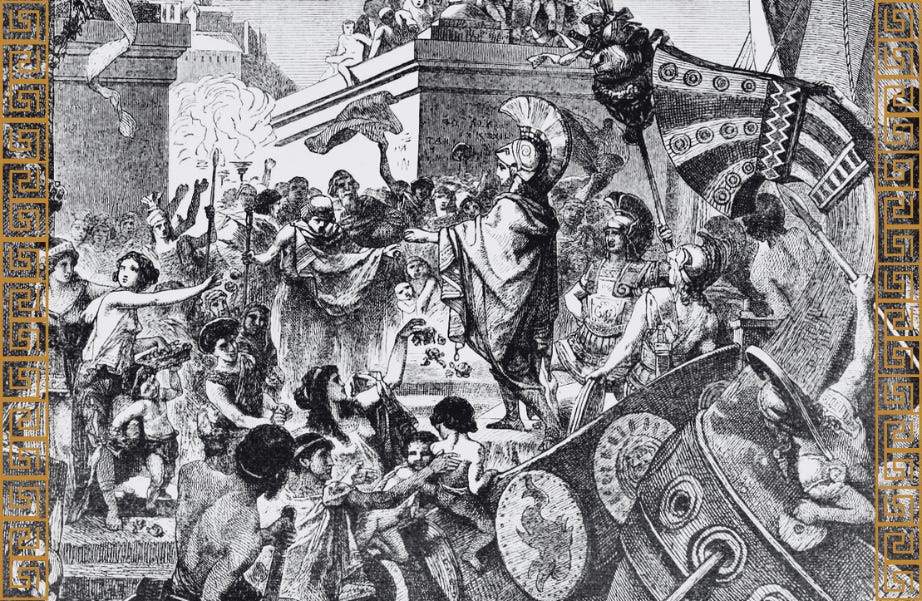
Ancient Greece demonstrated that it was possible to set aside petty rivalries to confront the existential threat of Persian conquest. Rivals one day and allies the next, the city-states were bound by the simple logic of survival: unite or perish. Hard-fought battles – from Marathon, to Salamis, to Plataea – were not just won by the bravery of the citizen-soldiers, but by their unlikely alliances.
And yet, the lesson was fleeting. Within a generation, the once-united Greek world turned on itself in a long, destructive, and totally pointless conflict. The Peloponnesian War was not one of conquest, but of pride. Whether driven by Athens’ ambition or Sparta’s insecurity, the Greek states spent nearly three decades in one of history’s most futile wars. Man’s fallen state produced a brutal civil war among former brothers-in-arms.
The pattern repeats itself centuries later. For generations, the fractured states of Christendom were forced to unite against another existential Eastern threat. As the brutality of Islamic invasions swallowed up whole swaths of the Christian world, the European kingdoms were faced with the same stark choice as the Greeks: unite or perish. The stakes were once again existential: failure to repel the repeated invasion meant not just defeat, but the potential eradication of Christendom.
History remembers the heroic battles: Antioch, Jerusalem, Lepanto, Vienna, Belgrade. These campaigns were often fought by coalitions of disparate Christian kingdoms, bound together by absolute necessity. When faced with annihilation, alliances formed, strategies aligned, and Europe was ultimately preserved. Future generations – including our own – owed their survival to the temporary unity that secured these victories. These moments were triumphs of pragmatism over pride, of necessity over petty ambition.
But in the centuries that followed, with the tide of Islam retreating to its former (albeit once-Christian) borders, Europe then turned on itself in the bloodiest civil wars known to mankind: the First and Second World Wars. It followed the same playbook as the Peloponnesian War. Pride, ambition, and insecurity began the wars; what followed were bloody, pointless years of destruction. The aftermath effectively ended the Old World: World War I toppled four great empires, and World War II completed the social and economic dismantling of the old European order. By 1950, less than 10 percent of the European aristocracy’s political power and land holdings remained. In a single generation, Christendom had been decimated by its own hand.
Why study these examples? Because they illustrate a fundamental truth about alliances: they are temporary, conditional, and fragile. In a perfect world, nations could rely on perpetual cooperation and live in eternal harmony. Unfortunately, we do not, nor have we ever, lived in that world. To assume that alliances alone will sustain global order is to court disaster. Alliances may delay conflict, but they can never eliminate the Original Sin of Man. A hypothetical, harmonious world order will always be undone by the underlying pride, ambitions, and insecurities that resurface in Men once external threats have passed.
Does this mean we should retreat into isolationism? Not at all. As the Trump Administration’s 2026 National Defense Strategy emphasizes:
“Ours is not a strategy of isolation… it is one of focused engagement abroad with a clear eye toward advancing the concrete, practical interests of Americans.”
This perspective is wise. Geopolitics must be approached with a clear-eyed focus on one’s own interests. Hobbes called it realism; Machiavelli called it prudence. Whatever the label, history vindicates this approach. Temporary alliances can safeguard survival, but the long-term pursuit of national interest is what ensures enduring security.
The American foreign policy establishment failed to follow this course for the last seventy years. Instead of pursuing our own interests on the international scene, they fecklessly adhered to the apparent “sacred obligations” of international order in pursuit of their global utopia.
But after decades of ritualistic subservience to the “sanctity” of global organizations like the U.N. and NATO, the latest National Defense Strategy has finally righted the ship. This is because the Trump administration, informed by history, fundamentally understands the brittle dynamic of these alliances.
If President Trump truly seeks to solidify his name as the President of Peace, he should remain laser-focused on the 2026 NDS’ vision for years to come.

Writing under the pen name Patricius Buchananus, the author works in conservative politics in Washington, D.C.